Chapter I: The Wild West of Butter
Before there was an "Association," there was chaos. In the late 19th century, the Tillamook Valley was a patchwork of small, fiercely independent creameries. Long Prairie, Fairview, Tillamook City—each a tiny kingdom unto itself.
But independence came at a cost. The isolation that made the grass so green also made the market cruel. Butter brokers in Portland played the farmers against each other, driving prices down. Quality varied wildly from farm to farm. A block of cheese from one valley might be divine, while another, miles away, would be fit only for the pigs.
The reputation of "Tillamook Cheese" was at risk before it had even truly begun. They realized that alone, they were just farmers in the rain. Together, they could be a standard.
Chapter II: The Architect & The Artisan
Two men stood at the center of the storm. Carl Haberlach was not a farmer; he was a salesman with the soul of a lawyer. He saw the potential for a unified brand that could command respect (and higher prices) in the city markets.
Beside him stood Fred Christensen, the technician. He was the disciple of Peter McIntosh, the man who had brought the secret of the "Cheddar" process to Oregon. Christensen knew that a brand was worthless without a product to back it up. He demanded not just cooperation, but submission to a single, rigorous recipe.
Chapter III: The Iron Standard
In 1909, the call went out. Ten creameries answered. They met not in a boardroom, but likely in a barn or a damp meeting hall, smelling of wet wool and milk.
The buy-in was steep in principle but modest in price: Ten Dollars. Each of the ten creameries laid down a ten-dollar bill. A total of $100 to start an empire.
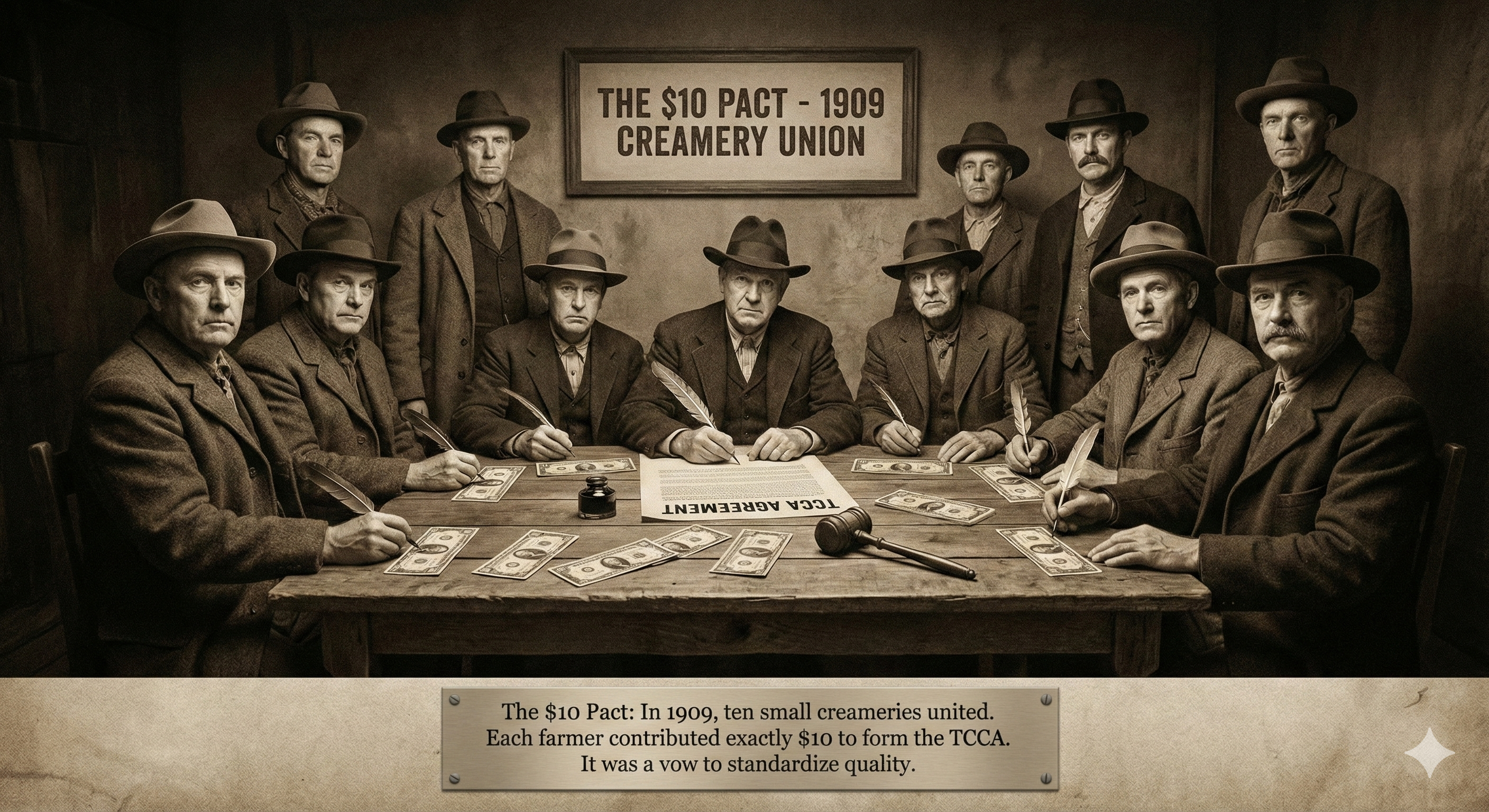
But the money was symbolic. The true cost was their autonomy. By joining the Tillamook County Creamery Association, they agreed to inspect each other's farms. They agreed to standardize their milk. They agreed that no cheese would leave the valley unless it met the "Iron Standard" of quality set by the cooperative.
"It was a vow. A handshake in the rain that said: 'My milk is your milk. My failure is your failure. And our glory will be shared.'"
That $10 bill did not just buy a share in a company. It bought a legacy. It purchased the right to demand excellence from a neighbor. Today, that pact remains unbroken, a testament to the fact that quality is not an accident—it is a decision.